
When a patient arrives at the CHU de Rennes with a skull base tumor, the management relies on a sequence of very specific skills: preoperative imaging, surgical planning, microsurgical procedure, and then postoperative follow-up coordinated with several specialties. Xavier Morandi has structured a significant part of this chain within the Rennes neurosurgery department, directing his career towards the most technical pathologies of the discipline.
Skull Base Surgery at CHU de Rennes: A Rare Specialization
The skull base concentrates at-risk anatomical structures (cranial nerves, arteries, brainstem) that make each intervention particularly delicate. Xavier Morandi has made this area his main field of expertise, with a referral activity on meningiomas, acoustic neuromas, and pituitary tumors.
This positioning in surgical neuro-oncology distinguishes his profile from that of a general neurosurgeon. To learn more about Xavier Morandi’s journey in Rennes, one can see how much this specialization has structured his entire academic and hospital career.
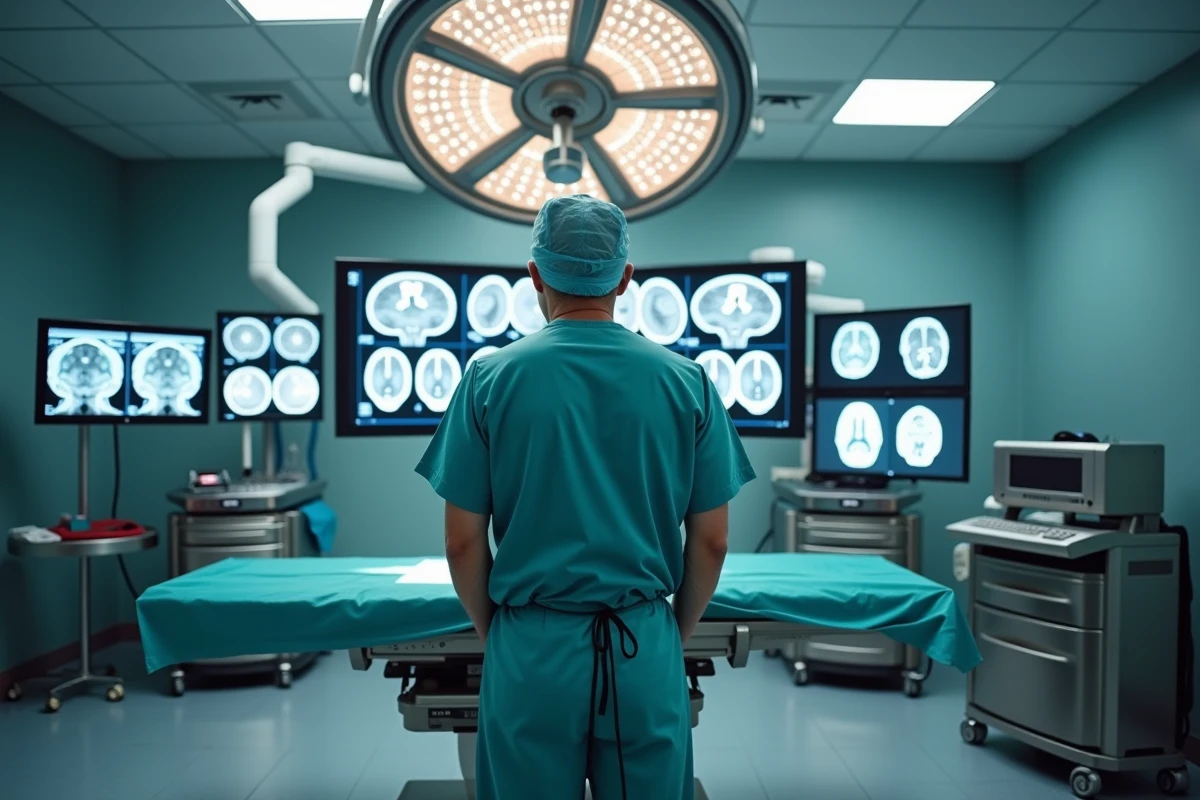
On the ground, operating on an acoustic neuroma means working just a few millimeters from the facial nerve. The margin for error is close to zero. This type of surgery requires not only technical mastery but also rigorous planning with the ENT, neuroradiology, and anesthesia teams.
Training Neurosurgeons in the Western Interregion: A Coordination Role
A surgeon can be excellent in the operating room without ever investing in teaching. Xavier Morandi has taken the opposite path by combining surgical practice with leading educational responsibilities.
He has served as the regional coordinator of the neurosurgery DES for the Western interregion. In practical terms, this involves organizing the training pathway for residents aiming for the specialty: choosing internship locations, validating skills, supervising theses and dissertations.
He has also directed several university diplomas (DU) and postgraduate courses. This academic aspect has a direct impact on the quality of care throughout the region: neurosurgeons trained under this coordination subsequently practice in Breton hospitals and beyond.
What This Structuring Changes for Patients
It is not always perceived from the waiting room, but the quality of a hospital service depends as much on the training of young practitioners as on the talent of the department head. A well-supervised resident during five years of specialization becomes a reliable operator. The coordination of the DES directly contributes to this reliability.
Neuro-Oncology and Rehabilitation: The Link with the Kerpape Center
Surgery does not stop at the closure of the wound. After the removal of a brain tumor, the patient may present neurological deficits (motor, sensory, cognitive) that require intensive functional rehabilitation.
Xavier Morandi has been involved in projects related to the Kerpape Center Endowment Fund, an institution recognized for its expertise in rehabilitation and technological innovation around disability. This partnership illustrates an approach that goes beyond the surgical act to integrate postoperative care.
- Patronage focused on innovation in rehabilitation, with assistive technologies for disabilities developed within the center.
- Direct link between the neurosurgical technical platform at CHU de Rennes and the rehabilitation teams at Kerpape, facilitating continuity in the patient pathway.
- Interest in devices that aid functional recovery, an area where technical advances (brain-machine interfaces, exoskeletons) are rapidly evolving.
This involvement in rehabilitation remains little visible in online practitioner profiles, which generally limit themselves to consultation slots and surgical acts. It nonetheless reflects a comprehensive vision of neurosurgical care, from the surgical indication to the patient’s return to autonomy.

Neurosurgery in Rennes: The Skills Behind the Specialty
Sometimes neurosurgery is reduced to the image of the surgeon alone facing the operating microscope. The reality at CHU de Rennes, as in any university center, relies on collective functioning.
Several skills are articulated around the referring neurosurgeon:
- The interventional neuroradiologist, who performs preoperative embolizations on certain highly vascularized tumors.
- The neurophysiologist, who monitors in real-time the integrity of the nerve pathways during the intervention (intraoperative monitoring).
- The pathologist, who analyzes tumor samples to guide complementary treatment (radiotherapy, chemotherapy).
- The neurocritical care teams, mobilized in the first postoperative hours.
This multidisciplinary organization conditions surgical outcomes. The rate of functional preservation after surgery depends as much on the technical platform as on the procedure itself. An experienced neurosurgeon, without appropriate monitoring, operates under degraded conditions.
The Issue of Surgical Volume
Centers that treat a large number of cases per year generally achieve better results. This link between volume and quality is documented in the neurosurgical literature. CHU de Rennes, as a regional reference center, concentrates complex cases from the West, which helps maintain a high level of expertise.
Xavier Morandi’s journey in Rennes fits into this logic of concentration of skills and transmission. Between skull base surgery, coordination of resident training, and investment in postoperative rehabilitation, his path illustrates what the title of university professor-hospital practitioner in neurosurgery concretely encompasses.
Patients consulting at CHU benefit from an ecosystem built over several decades, where each link (from the operating room to the rehabilitation center) contributes to the final outcome.