
Bank card, cash, restaurant vouchers, check: the payment options at Leclerc checkout seem familiar. The cooperative network, organized in independent stores under a common brand, allows each member some leeway on the accepted payment methods. This particularity creates disparities from one point of sale to another, and the arrival of new devices (split payment, instant transfer, charging stations compliant with the AFIR regulation) is gradually changing the landscape.
Instant transfer and open banking: an unknown channel at Leclerc
Most guides focus on bank cards and cash. A newer channel deserves attention: instant payment via SEPA transfer, deployed through the partnership between E.Leclerc and Wero. This system relies on open banking and allows for immediate debit from the customer’s account, without going through the card payment network.
For the brand, the interest is direct: the acceptance fees for a SEPA transfer are significantly lower than those charged by Visa or Mastercard networks on each card transaction. For the customer, instant transfer eliminates the delay between checkout and actual debit.
This payment method is currently mainly offered at the Drive. Its extension to physical checkouts remains to be confirmed depending on the stores. A detailed overview of Leclerc’s payment methods in-store allows tracking the evolution of these options over the months.
Split payment Leclerc: Oney and Réglo card
Two systems coexist to pay for a purchase in several installments within the Leclerc universe.
The partnership with Oney
Oney offers payment in three or four installments, accessible at the online cart validation stage. The service applies under minimum amount conditions. Processing fees are added to the total order amount, except during occasional promotions where splitting is offered without fees.
The Réglo Finance card
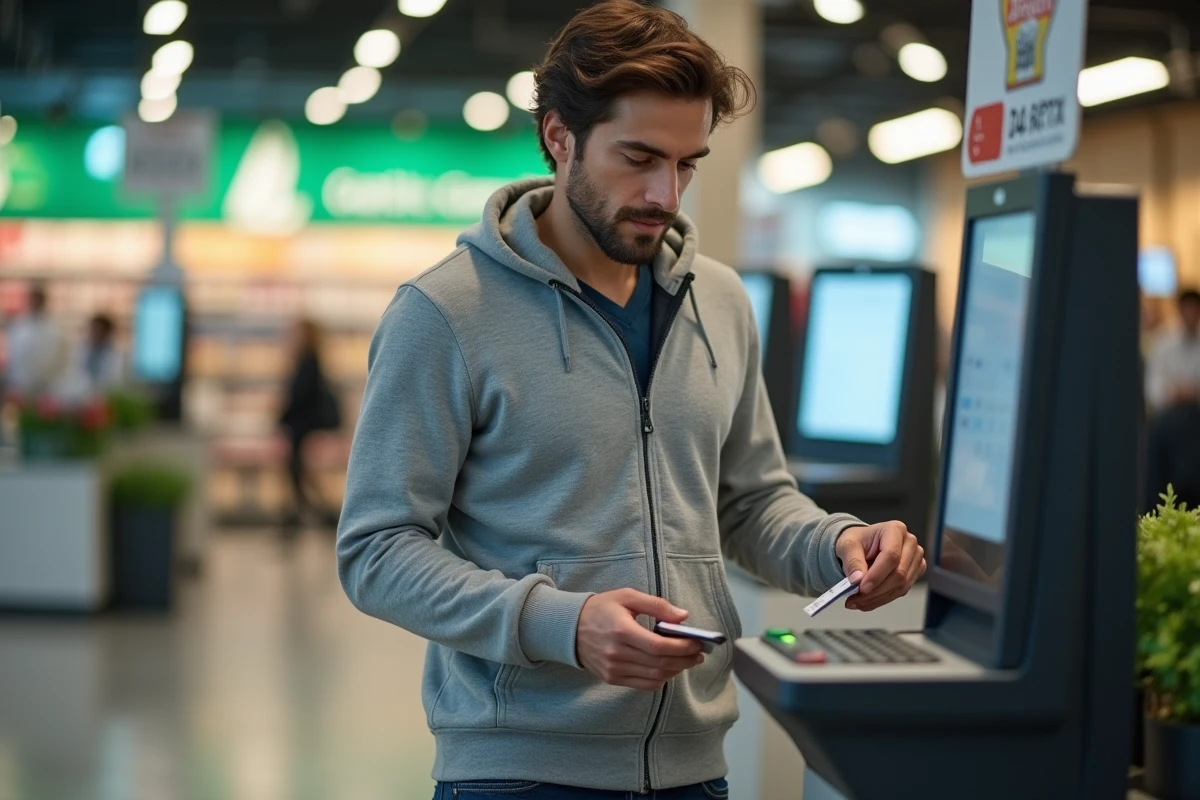
The Réglo card offers broader flexibility than simple three-installment splitting. It functions like a renewable credit reserve, usable in-store and on the website. The holder chooses to pay in cash or on credit at each checkout. Field reports vary on this point: some stores activate the Réglo card at automatic checkouts, while others reserve it for traditional checkouts.
Both solutions involve a creditworthiness analysis. A refusal for split payment does not necessarily indicate a banking incident: it may result from exceeding the authorized limit or inconsistencies in the transmitted information.
Accepted payment methods in Leclerc stores: variations between points of sale
The E.Leclerc network comprises independent companies operated by members. Each store constitutes a distinct business, with its own capital and management. This cooperative structure explains why accepted payment methods are not strictly uniform from one store to another.
The most common payment methods at physical checkouts are:
- Bank card (Visa, Mastercard, CB) with or without contact, including via smartphone (Apple Pay, Google Pay depending on installed terminals)
- Cash, with no regulatory limit for individuals residing in France
- Bank checks, accepted in the majority of stores but sometimes refused for small amounts
- Restaurant vouchers and lunch checks (paper or card) for eligible food products
- E.Leclerc gift card and Réglo Finance card
Holiday vouchers (ANCV) are accepted in certain cultural and travel spaces of Leclerc, but not systematically in food. The E.Leclerc loyalty card, on the other hand, does not constitute a payment method but allows accumulating and then using a bonus during payment.
Leclerc charging stations and AFIR regulation: card payment required
A rarely discussed aspect concerns the charging stations for electric vehicles installed in Leclerc parking lots. The European AFIR regulation (Alternative Fuels Infrastructure Regulation), which came into effect in 2024, imposes specific obligations on public charging station operators.
Two requirements directly modify the payment experience:
- Payment by bank card must be possible without the obligation to subscribe to a subscription or download an application
- The price per kWh must be clearly displayed before the charging begins
The E.Leclerc charging stations had to adapt their terminals to meet these constraints. Before AFIR, some stations in the Leclerc network operated exclusively via badge or dedicated application. The bank card becomes the universal payment method at public stations, including those located in brand parking lots.

Differences between Leclerc Drive and physical store for payment
Leclerc Drive and the physical store do not offer exactly the same payment options. At Drive, payment is made online at the time of order validation. Cash and checks are therefore not accepted. The bank card remains the main channel, complemented by Oney for splitting and, at some sites, by the instant transfer Wero.
In-store, the range is broader thanks to the acceptance of cash, checks, and restaurant vouchers. However, payment via Oney is not always available at physical checkouts: it depends on the store’s equipment and local agreements.
This distinction between online and physical channels is not unique to Leclerc, but it takes on a particular dimension in a network where each store manages its own contracts with payment providers. A service available in a Leclerc hypermarket in one city may not necessarily be available in the neighboring store, even under the same brand.
Before a significant purchase, checking directly with the relevant store remains the most reliable approach. The FAQ pages on the E.Leclerc website list the accepted payment methods for online orders but do not always cover the specifics of each physical point of sale.